Your Cat Doesn't Need Baths — And You Might Be Hurting Her Without Realizing It
When was the last time you bathed your cat?
Was it last week? Last month? Or the day you picked her up from the grooming salon and drove home smelling like a tropical fruit smoothie?
I'm going to tell you something that might make you frown: a healthy adult cat basically doesn't need you to bathe her. Not monthly, not weekly, and honestly, not even "sometimes."
This isn't me being contrarian for clicks. VCA (the largest network of veterinary hospitals in the U.S.), ASPCA, the Texas A&M College of Veterinary Medicine, and the AAFP all land in the same place on "should cats get baths": almost never, and brushing matters way more [1][2][3][10].
That caught me off guard when I first dug into it. Because "cats need a regular bath" is such a common belief among pet owners here. The American Veterinary Medical Association's 2025 Sourcebook counts 76.3 million pet cats living in 43.1 million U.S. households — that's 32.6% of all households [4]. And this is a serious industry: by the American Pet Products Association's count, U.S. pet spending reached $158 billion in 2025, with cat-only households averaging about $653 a year in food, vet care, toys, and grooming [5][4]. When a market that big carries a routine assumption, the assumption just kind of spreads. But the veterinary world has quietly disagreed with it for years.
So let me walk you through why "don't bathe your cat" isn't lazy advice — it's the advice most veterinarians actually give.
1. Cats came with a built-in bathing system
Let's start with the basic question: is a cat actually dirty?
The answer is: she cleans herself, and odds are she does it better than you do.
A cat's tongue is covered in tiny backward-facing barbs called papillae. They're basically a built-in brush and comb in one — designed to work dead hair out of the coat, lift dirt and dander off the skin, and redistribute the skin's natural oils. Cats spend a huge chunk of their waking hours grooming. That's not a nervous habit; that's their washing machine, and it's been running for thousands of years without you [1].
Underneath all that grooming sits the layer that actually keeps the skin healthy: a thin film of natural oils on the surface of the skin, which acts as a moisture barrier and the cat's first line of defense against dryness and irritation. Scrub that off too aggressively and you're removing the coat's own weatherproofing [1][9].
Dr. Alison Diesel, a veterinary dermatologist at Texas A&M, puts it bluntly: cats basically don't need their owners to bathe them [3].
So why is bathing a problem? It comes down to pH.
In 2011, a study published in the Journal of Feline Medicine and Surgery measured the pH of the cat's skin surface and found it sits around 6.39–6.64 — essentially neutral [6]. Interestingly, it varies by body region and even by sex: the study recorded a surface pH of about 6.94 in male cats versus 6.54 in female cats [6]. Human skin, by contrast, sits at roughly pH 5.5 — distinctly acidic.
Here's the translation: cats and humans run on different skin chemistry. Human skin is built to tolerate acidic cleansers. A cat's skin is built for a near-neutral environment. When you use a shampoo formulated for human skin on a cat, you're dragging an acidic product across a neutral surface — and stripping away the oil barrier at the same time. The result is a predictable cascade: dryness, flaking, itching, and more shedding. You wanted a cleaner cat. You got a cat with skin irritation instead.
That's the core of the whole "don't bathe your cat" argument. It's not that cats are self-sufficient hippies who reject hygiene. It's that their skin is engineered for a different chemistry than yours, and the more you wash it with the wrong products, the more you fight the system instead of letting it work.
2. "No bath" doesn't mean "dirty" — human shampoo is the real trap
I know what you're thinking: "Okay, but if I don't wash her, isn't she dirty?"
Here's the thing — "dirty" and "needs a bath" are two different categories.
What cats clean by licking is loose dust, loose fur, and surface grime. What actually makes a cat genuinely dirty — sticky food residue, paint or tar, a chemical spill, grease so heavy it mats the fur — is almost never something a scheduled bath would catch anyway. Those are one-off accidents that call for a one-off wash, not a routine.
What genuinely wrecks a cat's skin isn't neglect. It's human products.
Here's a story you'll recognize if you've spent any time in cat owner forums: an owner gives their cat a bath with a baby shampoo meant for human infants, thinking it's the gentlest possible option. Days later, the cat is shedding like crazy and starts hacking up foam after licking her coat. Terrifying moment. When the owner finally gets a straight answer, it's the same one vets have been repeating for years: human skin pH and cat skin pH are different systems, and baby products are still human products. They dry out feline skin, cause dander and hair loss, and can trigger allergic itching [11][13].
The dish-soap version of this story is even more popular on forums, and the answers there are uniformly grim: dish soap strips the skin barrier, causes hair loss, and can set up a skin infection. People try it because it "degreases" — but a cat's skin isn't a frying pan.
The uncomfortable truth: a lot of the "hygiene" we force on cats is us applying our standards to a body that runs on different chemistry. If you want a clean cat, let her do the 80% that she's been doing forever — and use your hands for the parts she can't reach (more on that in a minute).
A note on dander and allergies, while we're here
There's one more angle to this that's worth putting on the table, especially for anyone who lives with allergies. Federal health data from the CDC's NHANES surveys found that about 17.0% of the U.S. population (among adults over six) tests positive for cat allergens on a skin-prick test [7]. Now, sensitization isn't the same thing as symptoms — you can be sensitized and never sneeze once — but it tells you how common cat dander exposure is in this country.
Here's the connection to bathing: the allergen that makes people react isn't the fur, it's a protein in dander — dead skin flakes — and in saliva. Dry, irritated skin produces more dander. So the ironic loop goes like this: you bathe the cat more often to "control allergens," the shampoo strips the oil barrier, the skin dries out and flakes more, and you end up with more dander, not less [1][7]. Brushing — done outside, or with a filter in the room — removes loose fur and dander before they hit your furniture, which does more for allergy control than any sudsing session. It's another quiet case where less washing is actually better hygiene.
Before we move on, one honest caveat: no, I'm not saying human products are a guaranteed catastrophe on every single cat. Some cats get through a baby-shampoo bath with nothing worse than a grumpy afternoon. But it's a roll of the dice you don't need to take — there's no benefit to bathing a healthy cat, and there is a real, documented downside when the chemistry mismatches.
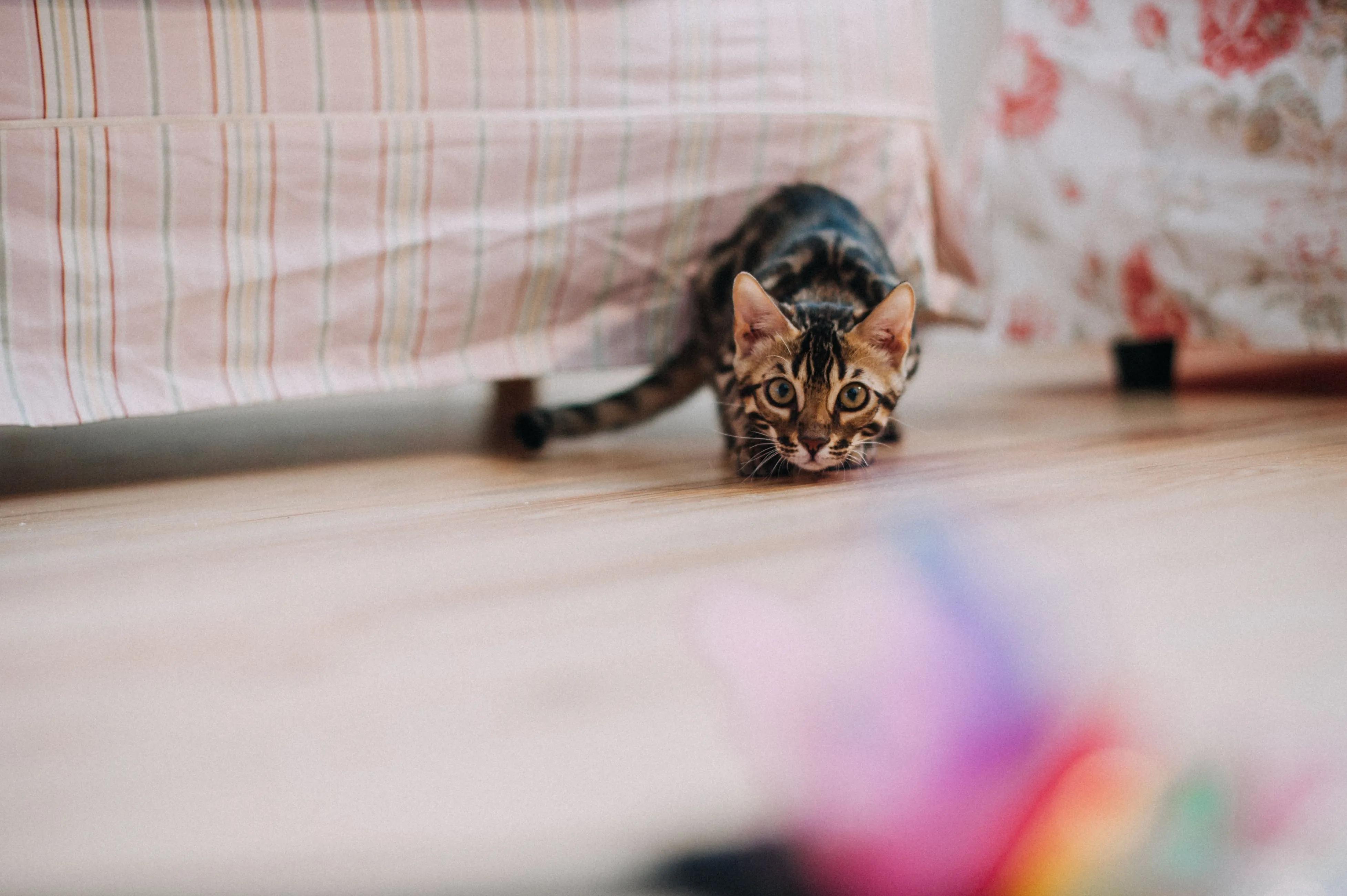
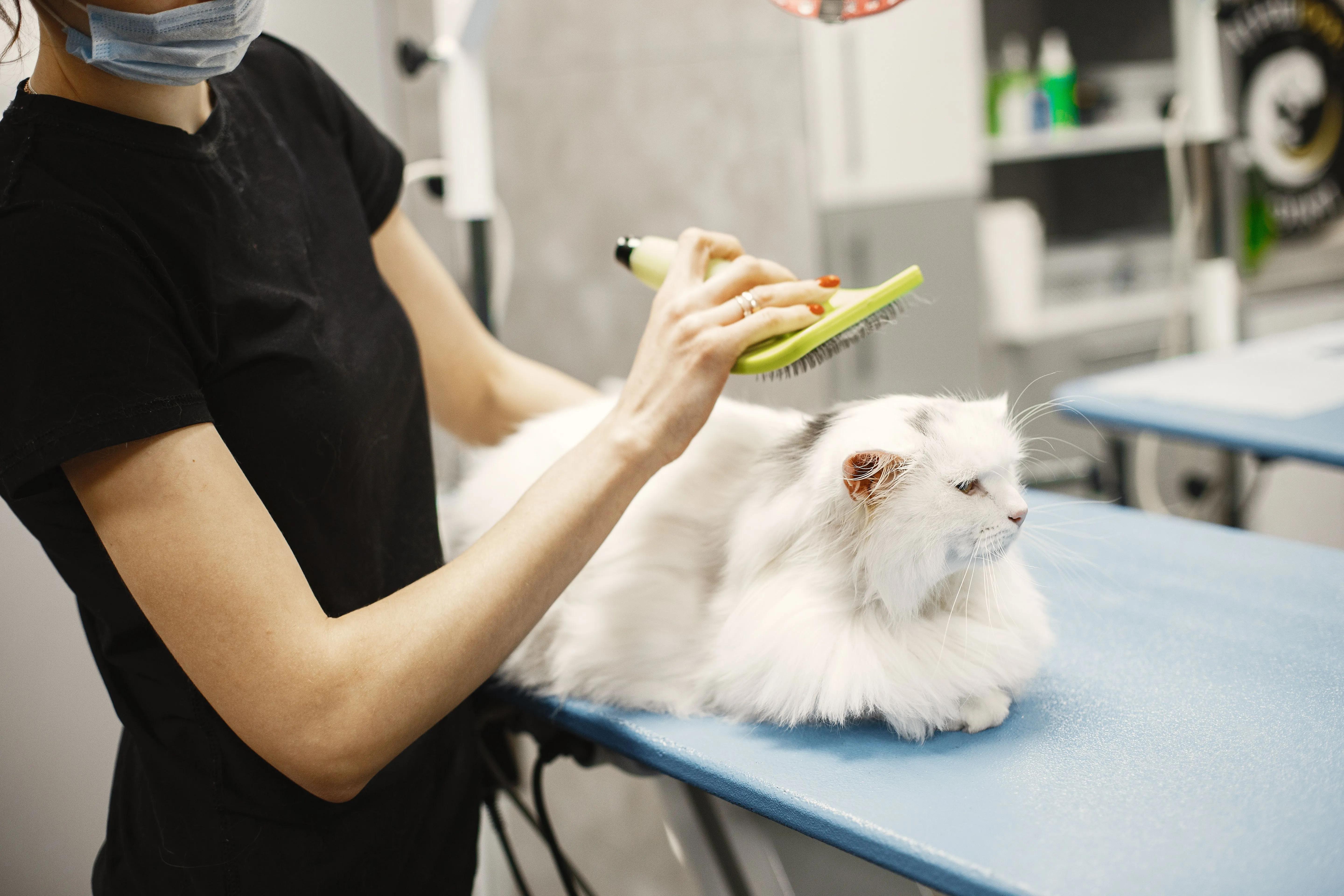
Brushing beats bathing: a few minutes with a slicker does the real work.
3. Brushing pays off more than anything else you can do
If "bathe less" is the subtraction, "brush more" is the addition. And this is where the authorities all agree: regular brushing is the single best daily care routine you can give a cat [1][2][10].
Brushing does four things that no bath can do:
1. Removes dead hair where the tongue can't. During shedding season, loose fur comes out in clumps. Brushing removes it faster and more completely than a rinse ever will, and it keeps it off your couch in the process.
2. Spreads the skin's natural oils evenly. Your cat's skin produces oil precisely so that her coat stays conditioned. Brushing redistributes that oil from the skin down the length of the hair shaft — essentially giving her a free, natural conditioner. Washing it away does the opposite.
3. Cuts hairball risk at the source. Here's the principle that got my attention: brushing regularly intercepts loose hair before the cat can swallow it during grooming, which is why Cornell lists daily brushing as the top way to minimize hairballs [12]. Every hairball is hair that went down the digestive tract because it never made it out of the coat — brushing intercepts it before the swallow. For the record, the occasional hairball is normal: a cat coughing one up every 1–2 weeks is within the normal range [12]. When they show up more often than that, it's worth a vet visit rather than just more brushing. But for the everyday case, brushing is the first and cheapest line of defense — cheaper than a hairball remedy, and better at preventing the problem in the first place.
4. A free skin check, every time. The SPCA points out that grooming is the perfect window to check for things you'd never notice otherwise: lumps, fleas, scabs, bald patches, unusual dander [9]. You're not just brushing; you're doing a 60-second physical exam while she purrs in your lap.
On the hairball piece, let me be straight with you about the "medicine" angle. Commercial hairball remedies — the gels and treats — do help some cats move swallowed hair through the system. But they're a Band-Aid on the pipeline: the hair is still going down. Brushing stops hair at the door, which is a fundamentally better fix than trying to escort it out the other end. That's not me trashing the products; it's just a ranking of where your effort pays off most.
So how often should you brush? It depends on the coat:
| Coat type | Brushing frequency | Tools that work |
|---|---|---|
| Short-haired (American Shorthair, British Shorthair, Siamese, domestic shorthair) | 1–2 times per week | Soft slicker brush, silicone grooming glove, wide-tooth comb |
| Medium-long hair (Maine Coon, Ragdoll) | 3–4 times per week | Long-tooth comb, pin brush |
| Long hair (Persian, Himalayan) | Every day | Fine-tooth comb, pin brush, mat-splitter |
During shedding season — the spring and fall blowouts — ramp everything up. For long-haired cats, twice a day isn't overkill at that point [1][9].
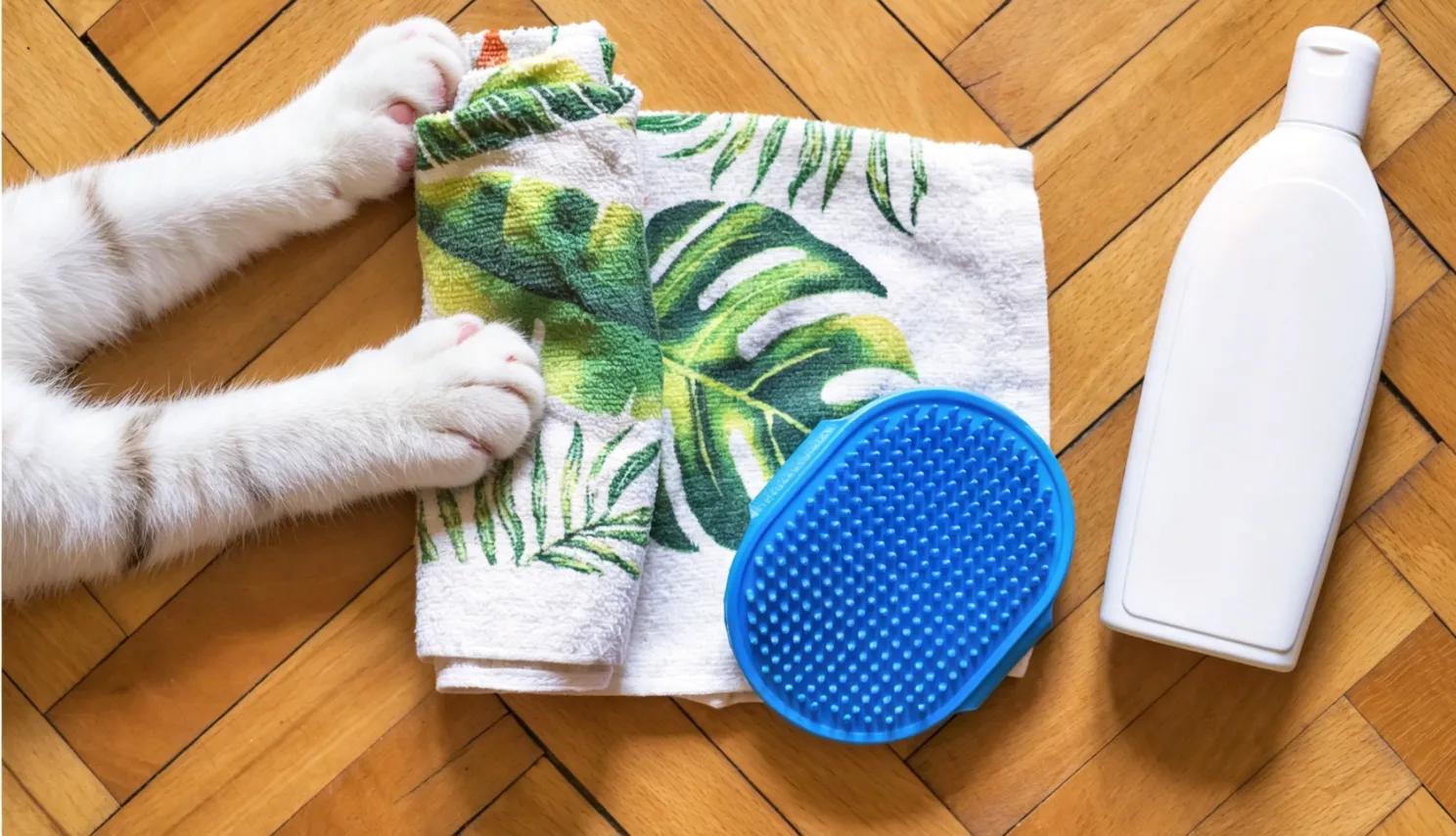
A note on gear: you don't need a fancy salon setup. A decent slicker brush runs $8–$21 on Amazon or Chewy [13]. A silicone grooming glove is $7–$13 [13]. If you want the heavy artillery for shedding season, a FURminator is the popular choice and generally runs $25–$35 [13]. Even at the top end of that range, it pays for itself the first week it stops a couch full of fur from happening.
Two practical tips before you start, learned the slow way: brush in the direction the fur grows — it's more comfortable and spreads oils the way nature intended — and keep the sessions short at first. Two minutes that end in treats are worth more than a twenty-minute wrestling match that ends in bites. Cats frame grooming as a social ritual, and a calm, consistent routine teaches them to look forward to the brush instead of dreading it. That single habit compounds over a cat's life: a cat who's comfortable being handled is a cat who's easier to examine, easier to medicate, and far less stressed at the vet.
The cost comparison is honestly a little funny. A cat shampoo for the occasional necessary bath runs about $7–$19 depending on brand [13]. A high-velocity pet dryer or drying box — which you'll want if you ever do bathe a long-haired cat — runs $87–$499 depending on how fancy you go [13]. Meanwhile, the grooming routine that actually keeps a cat's coat healthy runs you the price of a brush. It's a pretty small line item next to that $653-a-year baseline the AVMA tracks for a cat-only household [4] — but it's the line item that does the real work. The economics, the science, and every veterinary authority I found all point the same direction.
4. So when does a cat actually need a bath?
Let me be crystal clear: I'm arguing against frequent bathing, not ever bathing. There are genuinely four situations where a bath is the right call:
| Situation | What to do |
|---|---|
| A serious stain, toxin, or chemical exposure | Wash it, and wash it fast — this isn't optional |
| Medicated baths prescribed by a vet | Follow the prescription exactly; don't add anything of your own |
| Long-haired cat with heavy grease and mats | Oil so built up that the coat has begun to mat and won't comb out |
| Hairless breeds (like the Sphynx) | No coat to absorb oil, so oil builds up on the skin — these cats genuinely need regular cleaning |
Hairless cats are the honest exception to everything I just said. A Sphynx's skin has nowhere to put its natural oils, which means they do need periodic washing — Texas A&M suggests roughly every 1–2 weeks for hairless breeds [3].
For everyone else, the real frequency reference point is boring on purpose: a healthy adult cat getting a bath every 3–6 months is more than enough — and honestly, stretching longer than that is fine too. You'll see some pet care articles recommend "every 1–2 months," but the mainstream veterinary consensus — VCA, ASPCA, Texas A&M — is that healthy adult cats simply don't need it [1][2][3]. I know which source I trust more.
And if you do bathe her, the four golden rules (from the SPCA and mainstream veterinary practice) are: use a shampoo made for cats (never human products), water at 35–38°C (95–100°F), rinse completely so no residue is left to irritate the skin, and dry thoroughly on low heat — keeping the dryer nozzle about 8–12 inches (20–30 cm) from the coat so the hot air never sits against the skin — until no damp patch remains. Cutting any one of those corners does more damage than skipping the bath entirely [9][10].
5. Pet store baths: the risk you didn't sign up for
I hesitated before writing this section, because it's the easiest one to make terrifying. But the risk is real, and it's worth talking about in a level-headed way.
Cats are not dogs. Their ancestors came out of arid desert environments, and a deep-rooted fear of water runs through the whole species. For a nervous or sensitive cat, a pet store bath means a strange place, a stranger handling her, running water she can't escape, and the roar of a high-velocity dryer — that's a stack of stressors, all at once.
The anecdotal record, if you spend time in owner forums, has two recurring directions. There are the milder stories: a cat who came home from a salon bath and went days without eating or drinking. And there are the serious ones: cats who, after a stressful grooming session, developed a urinary blockage or acute kidney problems that required emergency vet care. I'm not going to dramatize the details — the pattern itself is enough to take seriously [13][14].
But here's the important part, and I want you to read it twice: the vast majority of cat baths are completely safe when done correctly. The issue was never "bathing is dangerous." The issue is that a salon environment, unfamiliar handlers, and no way to escape water can push an already nervous cat past her limit. A professional groomer who works exclusively with cats, uses low-stress handling, and knows how to read feline body language can wash a cat safely every single day of the week. I've read firsthand accounts from animal hospital staff who said their clinic only grooms dogs and turns cats away, or will only take a cat with a signed agreement — and that caution says more about the salon's honesty than about danger [13].
My practical advice if you're on the fence:
- Bathe at home if you can. The single biggest stressor reducer is a familiar environment — her own bathroom, your voice, no strangers.
- If you use a salon, choose one that explicitly works with cats, and stay for the whole appointment. Don't drop her off and leave.
- Do the long game. Build tolerance with treats and a grooming brush from kittenhood, so being handled is normal and boring instead of terrifying. Cats who've been gently habituated to being handled from an early age are measurably less stressed by grooming later in life [14].
Final word
Here's the thing about "clean": it's a human standard. A cat's idea of clean doesn't include a sudsy bath — it includes a smooth coat, oils in the right places, and a body that smells like home.
The best beauty routine a cat can have isn't an occasional deep clean. It's a few minutes of brushing every day — she gets comfortable, you get a built-in skin check, and somewhere in all that repetition the bond grows too. That's the version where everybody wins.
So: bathe less, brush more, watch the signals, and see the vet when something looks off.
Brushing is the real work. Bathing is the exception.
Furpick.app is a participant in the Amazon Services LLC Associates Program and other affiliate programs. We may earn from qualifying purchases. Content from Amazon and other retailers is provided 'as is' and subject to change. All trademarks are the property of their respective owners.