How to Bathe a Cat Without Turning Your Bathroom Into a War Zone
1. Why your cat acts like water is acid
Picture this. It's a Saturday afternoon, you've decided "today's the day," you run a shallow bath, you coax your cat in — and ninety seconds later the bathroom looks like a crime scene. Water everywhere. You're soaked. The cat is balanced on your shoulder like it's fleeing a flood, and you've picked up three fresh scratches that sting in a very personal way.
If you've been there, here's the part that used to confuse me: cats can swim. They're not drowning. So why the meltdown?
The first year I had a cat, I bathed him twice, and both times were exactly that scene. I was honestly puzzled until I read up on it. It's not that cats are bad at water. It's that their entire evolutionary history says water isn't their thing.
The domestic cat's ancestors were the African wildcat and related desert-dwelling cats, domesticated in the Fertile Crescent roughly ten thousand years ago [1]. Their home turf was dry scrubland and semi-arid country. In that world, water showed up the way it shows up for any small desert predator — rarely, and usually as something to avoid. Wet fur is heavy, which is a problem when your whole survival strategy is agility. Wet fur drops your body temperature fast, which is a problem for a small predator with a fast metabolism. And if you're standing on a slick surface with wet paws, you have no grip at all — which is why the moment a cat loses traction in a tub, panic sets in.
Now stack one more layer on top of that. When you hold a wet, airborne cat, you've just taken away its only escape route. That's the exact scenario a prey animal is wired to fight. A scared, slippery, suspended cat isn't being dramatic — it's following instructions that are ten thousand years old.
I'm not a zoologist, to be clear. I'm a person who read a lot about this and then watched the whole thing play out on my own cat's face. But the pattern is consistent across sources [1][2].
And here's the thing that made me want to write this whole guide: this is a common problem. The AVMA's 2025 data counts roughly 76.3 million pet cats in the US, spread across 43.1 million households — about 32.6% of American homes [4]. The American Pet Products Association put the whole US pet industry at about $158 billion in 2025 [5]. A third of households, hundreds of millions of dollars — and most of the "advice" floating around is either "never bathe your cat" or vague platitudes.
So let me say the thesis out loud, once: bathing isn't the problem. The method is. Get the method right, and "cat bath" stops being a four-letter word.
2. Does this cat actually need a bath?
Most new cat owners assume the answer is "yes, it's been a while." The honest answer for most cats is "no, not really."
VCA, the largest network of veterinary hospitals in the US, is direct about it: the vast majority of healthy adult cats rarely, if ever, need a bath [2]. The ASPCA and the Cornell Feline Health Center land in the same place [3][7]. Cats are self-cleaning in a way dogs aren't — a barbed tongue that works as a built-in brush and comb, plus a natural oil film on the skin that acts as a moisture barrier. Bathe too often and you're actively dismantling that barrier, which gets you dry skin, flaking, and more shedding than you started with.
So when does a bath actually make sense? Here's my comparison table:
| A bath actually makes sense | Leave the cat alone |
|---|---|
| The cat got into something toxic, oily, sticky, or chemical | The cat is sick, lethargic, or off its food |
| A vet-prescribed medicated bath (dermatitis, ringworm, allergies) | The cat just moved in and is still decompressing |
| A longhair with a greasy, heavily matted coat | A kitten that hasn't finished its vaccinations |
| A hairless breed like the Sphynx (they genuinely need oil control) | Within a week of deworming |
| An owner with serious cat allergies, trying to cut dander in the home | The cat goes full defensive the second it sees the bathroom |
Two boundary lines worth repeating, straight from veterinary guidance: kittens should finish their vaccination series and have adequate antibody coverage before a first bath, and it's best not to bathe in the week around deworming [2]. Both are "just don't" rules that save you from a set of problems you didn't know you were signing up for.
And the allergy angle deserves its own sentence, because it's the reason a lot of people reach for the shampoo. CDC survey data suggests about 17% of US adults test positive for cat allergens on a skin-prick test [8]. Sensitization isn't the same thing as sneezing, but if you're one of the people who does react, the instinct to bathe the cat makes sense. The catch: dry, irritated skin produces more dander, and stripping the oil barrier makes it drier — so bathing the wrong way can produce more allergen, not less. Brushing is usually the better lever, but a genuinely necessary wash done right isn't a bad idea either.
Now the frequency question, because I want to be consistent with what I've said elsewhere: for a healthy adult cat, a bath every 3–6 months is the ceiling, not the floor. It's an "if you must" number, not a "you should" number. You'll see some pet-care content recommend "every 1–2 months," and that sits on the frequent end of the range — I'd treat it as the conservative end of the spectrum, not the recommended end. Most cats can go much longer, and plenty go years without ever needing one.
Here's a stat that made me laugh when I found it: the AVMA's data puts average annual spending for a cat-only US household at about $653 — roughly $310 on food, $253 on vet care, $50 on toys, and $18 on grooming [4]. Eighteen dollars a year. The national spending pattern already knows the truth: grooming is a rounding error, and the vet bill is the thing worth protecting.
Translation: the bar for bathing a cat is higher than you think. A healthy cat that goes a year without a bath is normal. A healthy cat that has never been bathed is also normal.
3. The prep checklist: everything in reach before the cat walks in
This is the step people skip, and it's the step where most baths fall apart. My rule is simple: assemble everything, have it within arm's reach, and only then bring the cat in. Nothing derails a bath faster than realizing halfway through that you're out of towels and your cat is sitting there wet and furious on the bathmat.
Here's your list:
- Cat shampoo — non-negotiable. I'll explain why in a second.
- Non-slip mat or a towel on the tub floor — loss of traction is trigger #1 for panic.
- 2–3 absorbent towels — one isn't enough. You press-dry before you blow-dry.
- A pet dryer, or a hair dryer you can set to low or cool.
- Cotton balls for the ears.
- Treats — bribery, and aftercare.
Two pre-bath steps that aren't optional:
- Trim the claws. Otherwise you're volunteering for the scratch buffet.
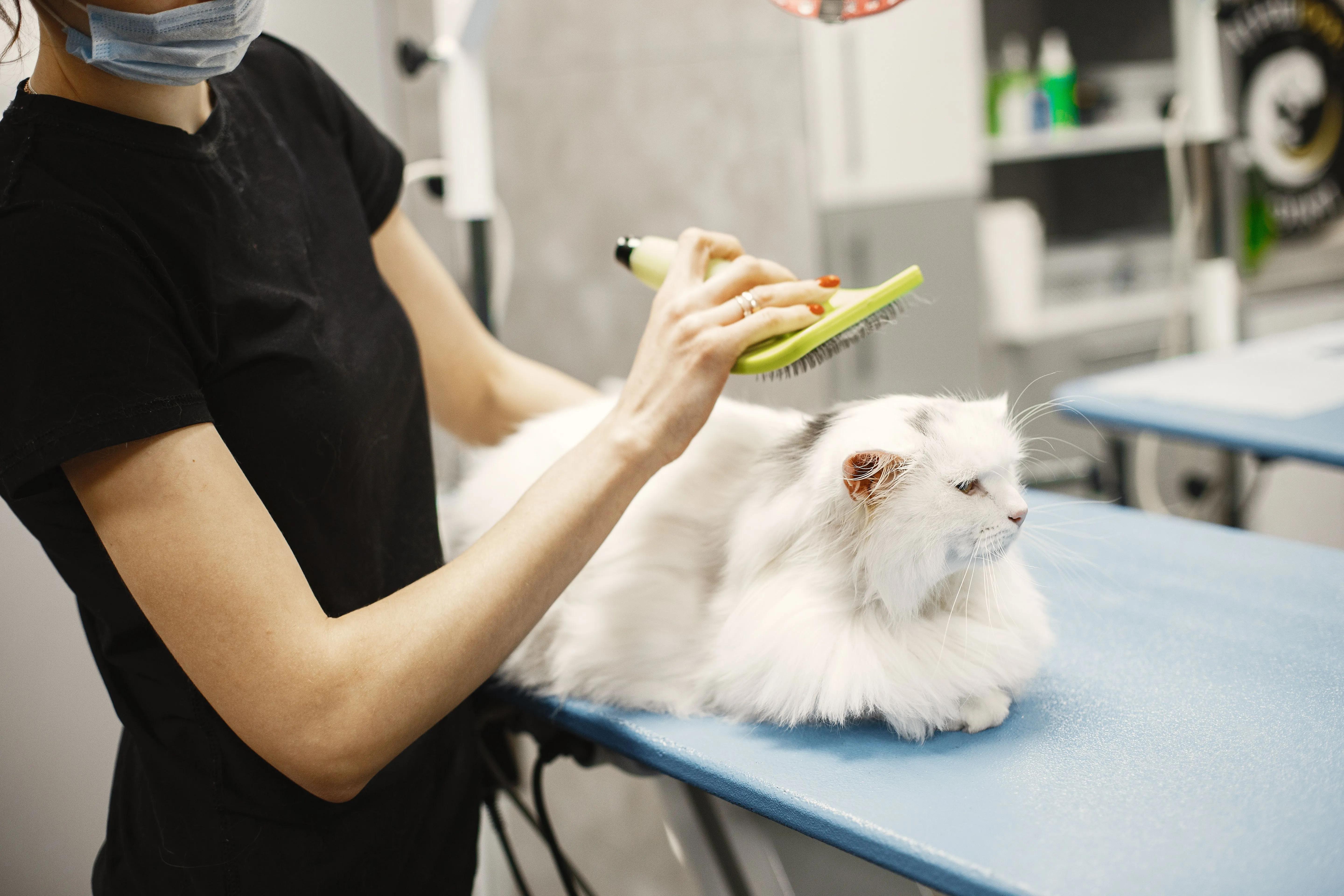
- Brush out every mat. Mats get worse the instant they hit water. They don't relax when wet — they tighten, and pulling them out then hurts a lot more.
Now the chemistry, because this is the single most common mistake in cat bathing — human shampoo, body wash, and especially dish soap have no business on a cat. A 2011 study in the Journal of Feline Medicine and Surgery measured cat skin pH at roughly 6.39–6.64, essentially neutral — and it varies by spot, from about 6.39 on the back up to 6.64 on the belly, with males trending a bit higher than females [6]. Human skin-care products are formulated around pH 5.5, distinctly more acidic. Use them on a cat and you're dragging an acidic cleanser across a near-neutral surface while dissolving the oil barrier at the same time. The predictable result: dryness, flaking, itching, more shedding, and in the worst cases, irritation bad enough to need a vet [7].
And here's the kicker — the price argument for the right shampoo is basically dead. In the US, cat-specific shampoos run roughly $7 to $19 at retail [9]:
| Product | Type | Retail price |
|---|---|---|
| Vet's Best Waterless Cat Shampoo (4 oz) | Waterless | ~$6.95 |
| TropiClean Cat Shampoo (12 oz) | Liquid | ~$17.99 |
| Earthbath Oatmeal & Aloe Cat Shampoo (16 oz) | Liquid | ~$18.99 |
| kin+kind Sensitive Skin Oatmeal | Liquid | ~$14.99 |
That's the whole range, top to bottom. There's no version of this where "saving money with human soap" makes sense — you'd be risking a ruined coat and a vet bill to save twelve bucks.
And a quick word on the anecdotal side, since this one comes up constantly in cat-owner spaces: there's a story that keeps circulating about someone who used a baby shampoo meant for human infants, thinking it was the gentlest possible option — days later the cat was shedding in clumps and hacking up foam after licking its coat. The owner was in tears. A scarier variant involves frothing at the mouth and an itchy allergic reaction. I can't verify every post, and I'm not going to pretend I can, but the pattern is consistent enough that I'd rather you not become the next thread [10].

Drying low and slow is where most home baths actually go wrong.
4. The 6-step bath method
Everything's ready. Here's the method, in order. It's not complicated — it's just deliberate.
Step 1 — Get the water right: 35–38°C (95–100°F), tested on your inner wrist. This is the mainstream consensus, and I'd hold the line here. Some guides will tell you 38–40°C and up is fine; don't test that theory on your cat. Cats tolerate less heat than you'd think — too hot is a burn risk, too cold is a stress response. Lukewarm, roughly skin temperature, and no more [2].
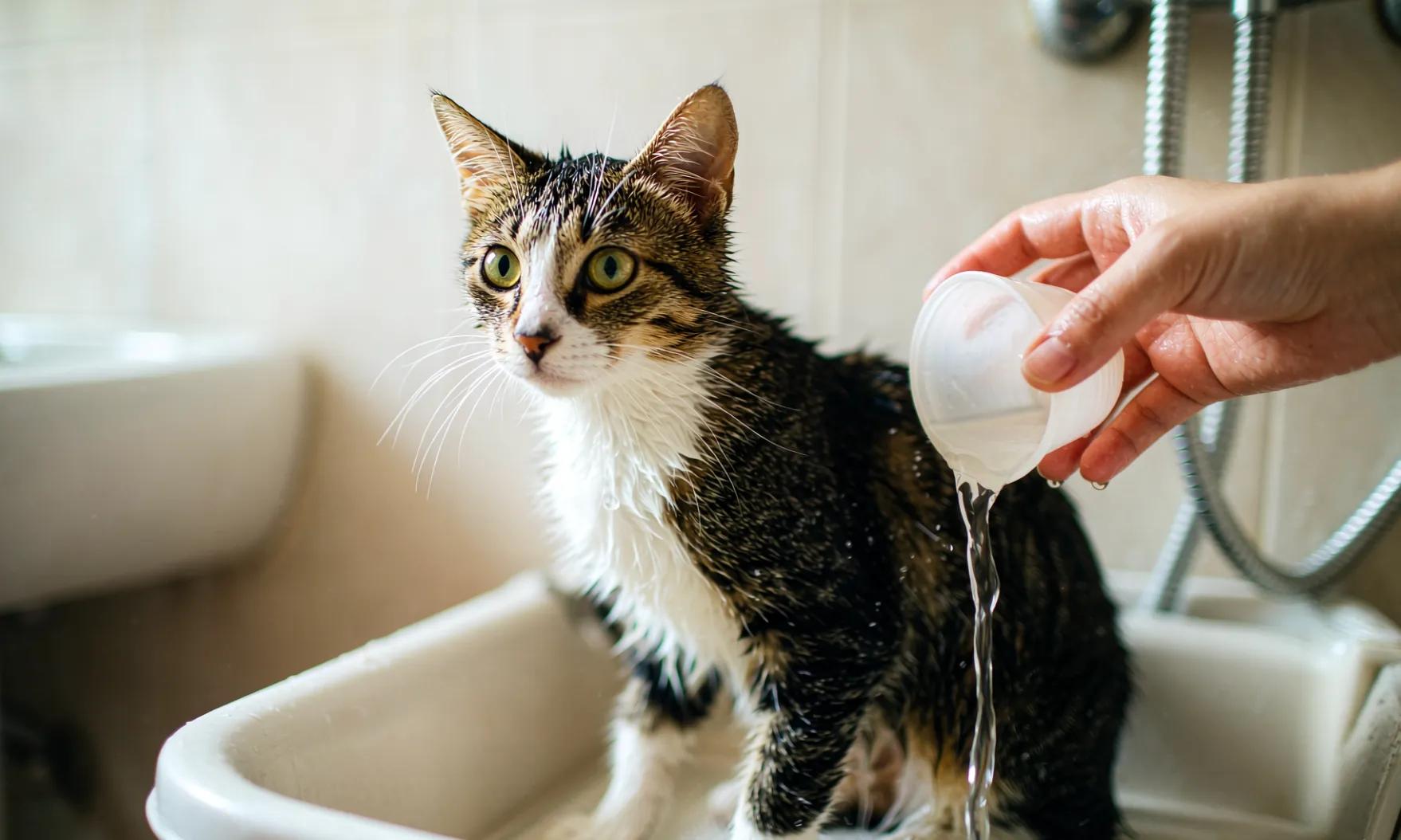
Step 2 — Wet from the back of the neck down. Never aim at the face. The sound of the sprayer plus water in the eyes is the single most reliable way to end a session early. Scoop water with a cup or your cupped hand and work from the nape of the neck down the back. Slow, deliberate, no surprises [2].
Step 3 — Work up a lather in your hands first, then apply from the neck back. Never glop the concentrate straight onto the coat. Thick, raw product sitting against the skin is hard to rinse out and over-stimulates. A small amount, lathered, goes further than a big glop [2].
Step 4 — The head gets a damp towel, not running water. Eyes, ears, nose — these are the three things a cat will fight you for. A towel wipe is plenty; the cat does the rest itself.
Step 5 — Rinse until the water runs completely clear. This is the step people skip, and it's the step that matters most. Leftover shampoo sitting on the skin is the classic setup for itchy skin and dermatitis [7]. Here's a groomer's trick I've stolen: when the coat is truly clean, the fur squeaks. Run a wet hand over it and it feels like wiping a mirror — that's your "done rinsing" signal. You can verify this next time.
Step 6 — Towel press, don't rub. Press and squeeze, don't scrub. Rubbing tangles the hair and damages the cuticle. Keep a second towel ready; press until there's no dripping.
One more thing that applies to all six steps: move fast, but don't rush. A cat's patience has a hard cap, and every extra minute reads as "this will never end." Keep your own voice and body calm — they absolutely feel it.
5. Drying: the real patience test
If you thought the bath was the hard part, you haven't met the dryer. Plenty of cats will endure the water and tap out the second the dryer clicks on. And it's exactly at this stressed, fragile moment that the most dangerous mistake in cat grooming happens: blasting high heat to "just get it over with."
Here are the hard parameters, straight from veterinary grooming guidance [2][11]:
- Low or cool heat only — pet dryer or hair dryer on the lowest setting.
- Hold 20–30 cm (8–12 inches) away and keep it moving — never park it on one spot.
- Brush as you dry, layer by layer. Against the grain first to get the roots, then with the grain to finish.
- The belly, armpits, and inner thighs must be completely dry. Not damp. Dry.
Now the case I want you to take seriously, and I'll tell it the way I'd want someone to tell it to me: there's a story that circulates in grooming discussions about a cat that came home from a bath, and by the next day there was a red bald patch on its back. The diagnosis was a heat burn from the dryer. The cat was also off its food and clearly miserable. I'm not going to dramatize the details — the pattern is enough. The moment you think you're "drying faster," you might be roasting the cat. Cat skin is dramatically thinner than human skin; its heat tolerance is not in our league [2][7].
So here's the trade-off, laid out plainly: damp fur roots are a breeding ground for skin problems — ringworm being the classic example. But a burn is a permanent scar. Between the two, slow is fast. Dry it right the first time, because "drying it faster" is how you end up with a vet visit.
Should you buy a drying cabinet? The short answer is: maybe. They're real products with real fans — owners routinely describe their bathing workload dropping to a fraction of what it was once they had one [10]. But there's a precondition: the cat has to tolerate enclosed spaces. A cat that panics inside the box is worse off than a cat being hand-dried. If you can, try before you buy — or borrow one.
If you're shopping in the US, here's the market [9]:
| Category | Examples | Price range |
|---|---|---|
| Drying cabinet (entry) | ADVWIN, UNICOO | $87–$160 |
| Drying cabinet (mid-range) | HomeRunPet Drybo Plus | $185–$212 |
| Drying cabinet (premium) | PvEvTv, PetSnowy SMILE | $359–$499 |
| High-velocity dryer | Flying Pig (High Velocity / One / One Plus) | $187–$237 |
That's real money, so it's worth repeating the precondition: buy the hardware only if the cat isn't terrified of it. A $499 cabinet that scares your cat into a panic is a very expensive way to do more harm than good.
6. Top 5 bathing mistakes
I've scattered warnings through the whole piece, so let me collect the top offenders in one place. Chances are you've hit at least one of these:
Mistake 1: Human shampoo, body wash, or dish soap. The pH mismatch is the whole story — cat skin is near-neutral, human products are acidic, and dish soap is a literal degreaser built to strip oil [6]. Hair loss, dandruff, allergic itching, foam. Every version of this story ends badly [10].
Mistake 2: Bathing on a schedule. A healthy adult at 3–6 months is the ceiling, not the floor [2]. Bathing weekly strips the barrier over and over, and the result is a drier, flakier, more shedding cat than the one you started with.
Mistake 3: Shampoo residue. If it doesn't squeak, it's not rinsed. Residue left on the skin is a chronic irritant and a setup for dermatitis [7].
Mistake 4: Sending a half-dry cat out into the world. Surface dry isn't dry. If the roots are still damp — especially on the belly, armpits, and inner thighs — you've handed a skin problem a perfect place to start [2].
Mistake 5: Forcing it, including the head. The head gets a damp towel, not a rinse. And if the cat is genuinely frantic, stop. The ASPCA and SPCA are consistent on this: don't force a cat that's fighting you [3][11]. Forcing just adds stress and scratches, and it teaches the cat that the bathroom is a war zone — permanently.
And one more time, from the top: fear of water is baked into the cat's wiring [1]. You're not going to out-argue evolution. You can out-prepare it — that's the whole playbook above — but you can't out-force it.
7. The bottom line: the goal is "the cat comes out unharmed"
Here's the part where I get earnest for a second.
Bathing a cat is not a box you check on a schedule. It's a when-needed action. The whole SOP, compressed to five lines:
- Don't bathe on the human clock. Healthy adult, 3–6 months is the ceiling — most cats need far less [2].
- Don't use human products. Cat shampoo is your first line of defense [6].
- Water at 35–38°C (95–100°F), wet from the neck down, keep the head out of it [2].
- Rinse completely clear, dry on low heat — bone-dry the belly, armpits, and inner thighs [2].
- If the cat is genuinely fighting you, stop. Hand it to a professional groomer. Respect the cat [3][11].
The thing I want you to fear isn't "I didn't bathe my cat enough." It's "I bathed my cat and hurt it." A bath exists for the cat's comfort, not your standards of cleanliness. A cat that comes out unharmed, dry, and not permanently traumatized isn't a failed bath — it's a perfect one.
So decide first, prep properly, run the six steps, dry low and slow, and let the cat tell you when it's had enough. That's the whole method. And that's how a cat bath stops being a war zone.
Furpick.app is a participant in the Amazon Services LLC Associates Program and other affiliate programs. We may earn from qualifying purchases. Content from Amazon and other retailers is provided 'as is' and subject to change. All trademarks are the property of their respective owners.