Cat Flea & Tick Prevention: Recognize, Treat, Prevent, and Know When to Call the Vet
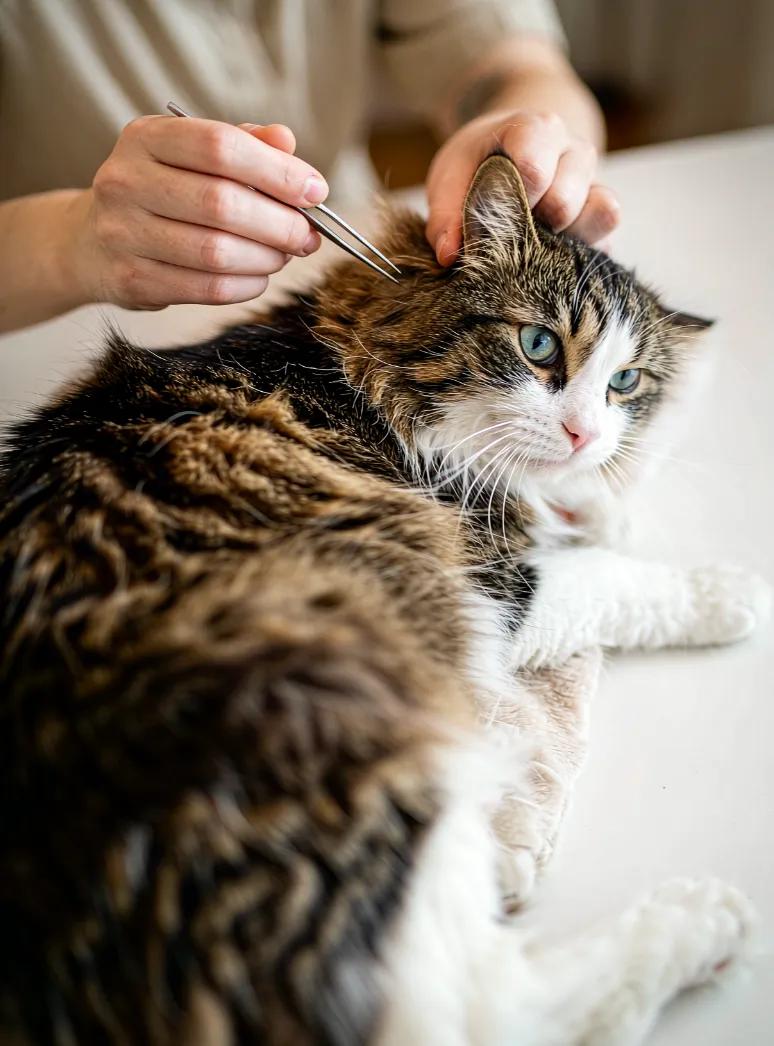
First, take a breath. You're not alone in this.
It starts the same way for almost everyone. Your cat's been scratching a little more than usual. Then a lot more. You part the fur at the base of the tail and see scabs, maybe some tiny black specks. You tell yourself it's just dry skin. Then you lie awake at night wondering if it's fleas — and if it is, what you're supposed to do about it.
I've been there — standing in the pet aisle, staring at a wall of flea products, more confused than before I walked in. The online answers don't help either: half the forums tell you to panic, the other half say it'll just go away. Neither is right.
So let's fix that. This is the flea-and-tick playbook I wish I'd had — written the way a vet would actually walk you through it. Four steps: recognize, treat, prevent, and know exactly when to stop guessing and call the vet.
There are about 73.8 million pet cats in the United States [1], and external parasites are one of the most common health issues they bring to the vet. The good news? With the right routine, most of this is very manageable. Here's how.
Recognize: The 3-Minute Check
You don't need a microscope or a veterinary degree. You need a fine-toothed flea comb, a white paper towel, and about three minutes.
First, the signals. Fleas make cats scratch — that's expected — but the scratching follows a pattern. The classic sign is scratching, licking, or chewing at the base of the tail, the back, and the neck [2]. In cats with a sensitivity to flea saliva, this turns into actual skin damage: scabs, hair loss, red bumps. Vets call it flea allergy dermatitis, and even a single bite can set it off in a sensitive cat [3].
But finding the fleas themselves is the tricky part: cats are incredibly good at grooming them away. You can have a real flea problem and never spot a single live flea on the cat. That's why the evidence matters more than the insect.
That evidence is called flea dirt — essentially dried blood the flea excreted after biting. It shows up as small black specks or tiny comma-shaped curls in the fur [4].
Here's the check — and it takes less time than waiting for your coffee to brew:
- Comb your cat's fur backward, especially along the back and base of the tail.
- Tap whatever comes off the comb onto a damp white paper towel.
- Wait a few seconds. If the specks spread into reddish-brown streaks, that's dried blood. Positive for flea dirt.
That reddish smear is the closest thing to a home diagnostic test you'll get. It means fleas have fed on your cat. Not maybe. Almost certainly yes.
Now, ticks are a slightly different game. You check for them the same way — combing and running your hands through the fur — but you're looking for a small brownish bump that's attached to the skin, often around the head, neck, and ears. If you find one, don't panic: the Cornell Feline Health Center notes that most ticks don't carry disease, and tick-borne illness in cats is actually uncommon [5]. We'll get to the safe way to remove one in a minute.
Treat: The Cat, Not Just the Feeling
Most people "treat" fleas the same way: put one dose of something on the cat, see fewer fleas for a few days, and call it done. A month later, it's back. That's not a treatment failure — that's a life-cycle misunderstanding.
This is the reality you're fighting. A single female cat flea can produce up to 40 to 50 eggs a day [4]. The flea's full life cycle — egg, larva, pupa, adult — can run as fast as 12 to 14 days under ideal conditions, or stretch out as long as 350 days [4]. Here's the number that matters most though: of the fleas in your house, only about 5% are actually on your cat. The other 95% — the eggs, larvae, and pupae — are living in your carpet, your couch, your baseboards [6].
That's why "treat the cat and ignore the house" always fails.

So what does treating your cat actually look like? This is where I'm going to stay deliberately vague on products, because the right choice depends on your cat's age, weight, and health — that's a vet conversation, not a blog post. What I'll tell you is the shape of it:
- Fast-acting options that kill fleas quickly (often within hours) are common first moves [4].
- Monthly preventives — topical drops or oral meds — are the ongoing backbone. Depending on the product and brand, cat flea prevention typically runs about $15 to $25 a month, or roughly $180 to $300 a year [7].
- Whatever you use, read the label for the weight range. Guessing is how overdoses happen.
And one more thing that belongs here, because it can be a literal lifesaver:
Never, ever use a dog's flea product on a cat.
I'll say it again, because it's that important. Cats are extremely sensitive to a class of compounds called pyrethrins and pyrethroids — the active ingredients in many dog-specific spot-ons. Their livers just can't break them down the way a dog's can [8]. Even a small amount can trigger drooling, tremors, trouble walking, seizures — and in some cases, it's fatal. The most common cause of poisoning, according to VCA Animal Hospitals, is someone putting a dog product on a cat [8]. The CDC puts it in one flat sentence: never use products containing permethrin on cats [9].
If your cat has any contact with a dog that was just treated, keep them separated for 12 to 24 hours, until the product is fully dry [8]. And if you ever suspect poisoning, call your vet or the Pet Poison Helpline at 1-800-213-6680 immediately [8].
Treat: The House (Yes, This Part Matters)
Here's the part nobody wants to hear, because it's actual work. I've scrubbed baseboards on my hands and knees — I know. But it's the difference between a two-week problem and a six-month one.
Since most of the flea population lives in your environment, treating the house is not optional — it's the other half of the equation. The Merck Veterinary Manual is blunt about the goal: kill the fleas on the pet, remove the source in the environment, and prevent reinfestation [4]. All three.

The practical version:
- Vacuum like you mean it. Carpets, rugs, under furniture, along baseboards. Pay special attention to cracks and crevices. Dispose of the bag or empty the canister outside afterward [4].
- Wash everything the cat touches — bedding, blankets, cushion covers — in hot water [4].
- Treat the environment if it's a real infestation. Products with insect growth regulators (IGRs) stop eggs and larvae from maturing, which is the key to breaking the cycle [4].
Now, temper your expectations, because this is the part that frustrates everyone. Even if you do everything right, existing fleas in the environment mean full control can take two to three months [4]. That's not you failing. That's the pupae stage — fleas in cocoons can sit dormant for weeks or months, waiting for the right moment to emerge. You're basically waiting out the life cycle.
And the "I used the product but I still see fleas" panic? Also normal. Most preventives aren't repellents — they kill fleas that bite. A flea can live 6 to 24 hours after contact before the product kills it [4]. Seeing a few fleas in the first couple weeks of treatment is expected, not a red flag.
Prevent: Make It a Year-Round Habit, Not a Seasonal Hobby
Here's the myth that keeps vets in business: that fleas are a summer problem. They're not.
Fleas thrive indoors year-round — your climate-controlled home is basically a flea spa in every season. That's why the Companion Animal Parasite Council (CAPC) is unambiguous: year-round, uninterrupted prevention is the recommendation, not a seasonal "stop in October" approach [10]. Their point is simple: a here-and-there prevention routine isn't the best way to protect your pet — or your family [10].
So the actual habit looks like this: a monthly preventive, every month, all year. Not because your cat is outside a lot — indoor cats get fleas too (humans carry them in on shoes and clothing, and flea pupae can hitchhike into the home) [4]. Prevention is cheaper and easier than treatment, and it spares your cat the itching and the risk.
Worth adding: CAPC's 2026 forecast doubled down on this, pointing to a new era of year-round risk as parasite geography shifts [11]. The "cold winter, no fleas" assumption is getting weaker by the year.
The Tick Side: Check, Remove Safely, and Know When It's Urgent
Ticks get less attention than fleas with cats, probably because indoor cats rarely pick them up. But if your cat goes outside — even to a yard — or if you have dogs, ticks are worth a couple of minutes of your time.
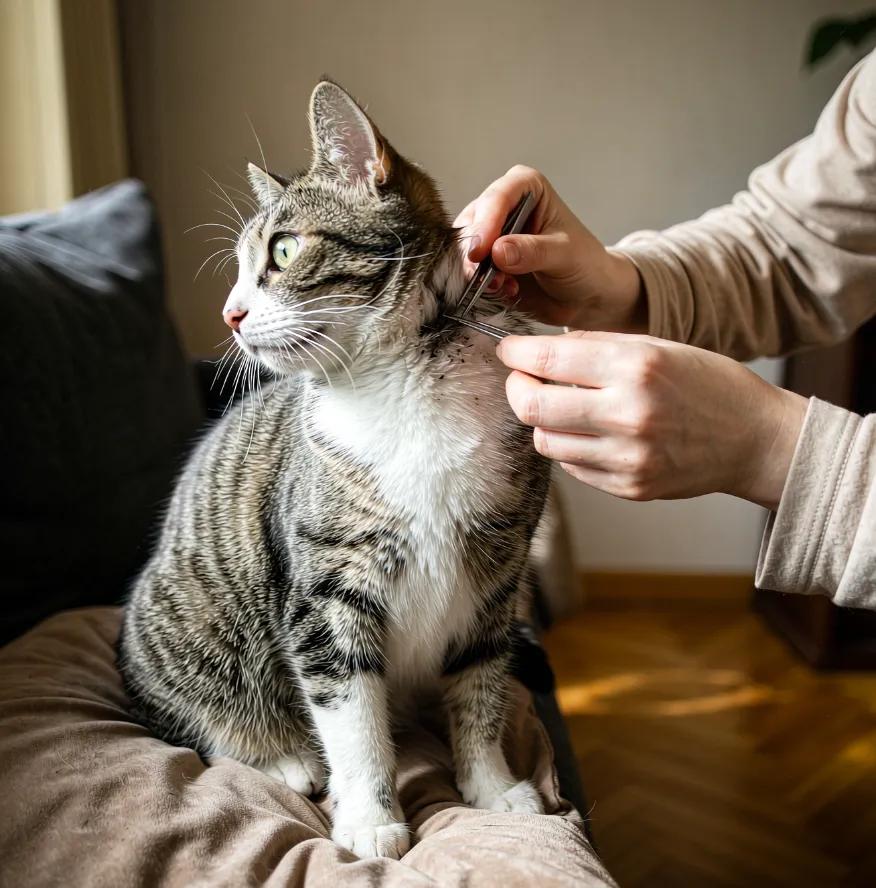
Cornell's Feline Health Center is the voice I trust here. Their key points [5]:
- Tick-borne illness in cats is uncommon, and most ticks don't carry disease. Don't panic.
- But some tick-borne diseases in cats are serious. One — cytauxzoonosis — is often fatal, with signs like severe anemia, fever, lethargy, and trouble breathing [5]. Another, tularemia, has a poor outlook in cats [5].
- Signs to watch after a tick exposure: fever, lethargy, joint stiffness or swelling, loss of appetite. Any of these means a vet call [5].
If you find a tick on your cat, here's the safe removal, straight from Cornell [5]:
- Use fine-tipped tweezers or forceps.
- Grasp as close to the skin as possible — right at the tick's mouthparts where it's attached.
- Pull straight out with steady, even pressure. Don't twist or jerk.
- Make sure you got the whole thing. If it's a female, the body can contain eggs — dispose of it in a sealed jar with rubbing alcohol, and use gloves.
Then wash your hands. Ticks can transmit disease to people too, so gloves and cleanup aren't overkill [5].
If you're not comfortable removing it, or you're not sure you got it all, call your vet. Better a slightly awkward phone call than a missed mouthpart.
Know When to Stop Guessing and Call the Vet
The whole point of this framework is that most flea situations don't need an emergency vet visit — they need a routine and some patience. But there's a line, and crossing it changes the answer. Call your vet when:
- Your cat is lethargic, not eating, or seems genuinely unwell.
- You see pale gums — a sign of anemia, which can happen with heavy flea burdens, especially in kittens [4].
- The scratching is severe enough to break skin or your cat is clearly miserable.
- You've been treating consistently for a few weeks and things aren't improving.
- You suspect flea medication poisoning (drooling, tremors, seizures) — this one's an emergency. Call the vet or Pet Poison Helpline immediately [8].
And the health angle that most people overlook: fleas aren't just a nuisance. They're a disease vector. Fleas carry the tapeworm Dipylidium caninum, which cats get by swallowing a flea while grooming [12]. They're also tied to Bartonella henselae — the bacteria behind cat scratch disease — which can spread to people through a scratch contaminated with flea dirt [9]. Here's the stat that makes this concrete: about one in three healthy cats carries B. henselae in their blood [9]. Year-round flea prevention isn't just about your cat's comfort. It's about your family's health too.
The One-Line Takeaway
Fleas are a life-cycle problem, not a single-bite problem: recognize early, treat the cat and the house together, prevent all year, and when your gut says something's off — call the vet. You've got this. Your cat's got you.
Furpick.app is a participant in the Amazon Services LLC Associates Program and other affiliate programs. We may earn from qualifying purchases. Content from Amazon and other retailers is provided 'as is' and subject to change. All trademarks are the property of their respective owners.